Drop C Tuning
What drop C actually is, how to get there from standard or drop D, and what your strings and setup need to cope with the lower pitch.
In this piece
What is drop C tuning, and how do you get a guitar there without it turning into a loose, buzzing mess? The short answer: it is drop D moved down a whole step, and it works best with slightly heavier strings and a quick check of the setup.
The notes and how drop C relates to drop D
From the lowest string to the highest, drop C is tuned C G C F A D. In scientific pitch notation that is C2, G2, C3, F3, A3 and D4. The top five strings are the same as D standard (D G C F A D), which is every string of standard tuning lowered by a whole step. The sixth string then drops one more whole step, from D to C.
The easiest way to understand it is as drop D shifted down. Drop D is D A D G B E; lower every string by a whole step and you land on C G C F A D. The relationships between the strings stay the same, so every shape you know from drop D still works. Most importantly, the bottom three strings form a root-fifth-octave power chord that can be played with one finger across a single fret.
How to tune by ear and with a tuner
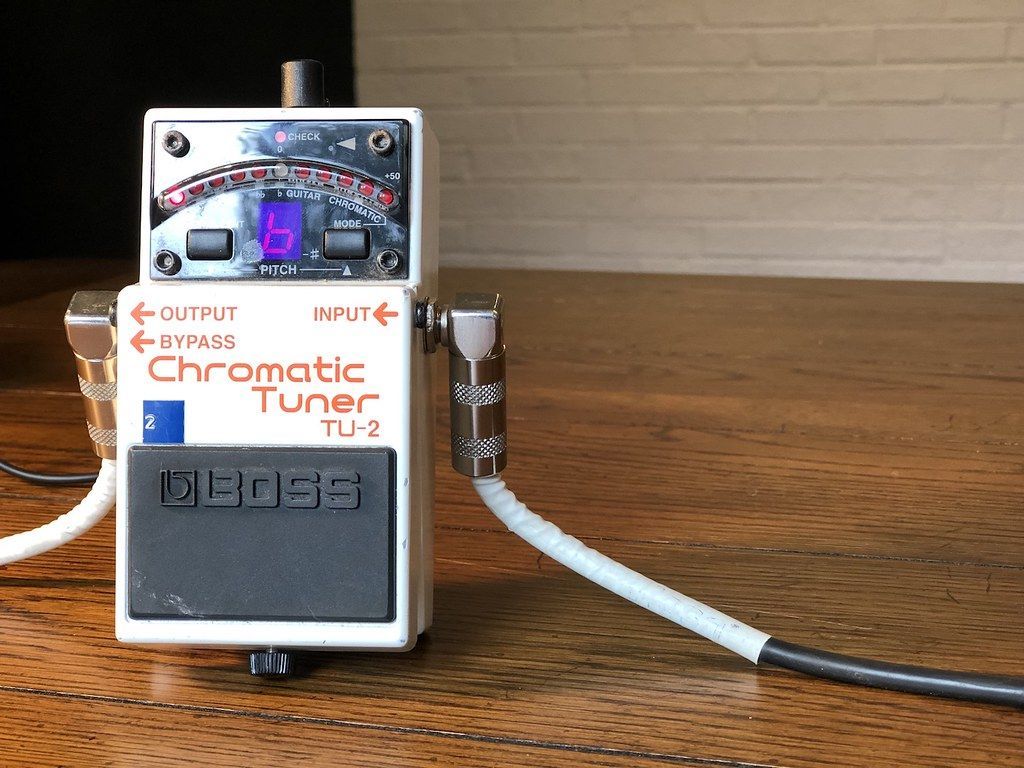
With a chromatic tuner, the job is simple: tune each string to the target note, starting with the lowest one, then go round a second time, because lowering several strings changes the tension on the neck and the first strings you tuned will drift. A clip-on tuner or a pedal tuner both work; just make sure it reads chromatic notes rather than only the standard E A D G B E.
By ear, start from a reference D for the first string, then use the usual fretted-unison method adjusted to the new intervals. The fifth fret of the fifth string (G) gives the open C of the fourth string; the fifth fret of the fourth string (F) gives the open third string; the fourth fret of the third string (A) gives the open second string; the fifth fret of the second string (D) gives the open first string. For the sixth string, the open C should sound one octave below the open fourth string, and its seventh fret (G) should match the open fifth string.
Strings, setup and the riffs it suits
Lowering the pitch while keeping the same strings lowers the tension, so a standard set can feel slack, flap against the frets and go sharp when you dig in. That is why many players move to heavier or heavy-bottom sets for drop C. String makers such as D'Addario and Ernie Ball sell balanced and heavy-bottom sets aimed at lower tunings, and their gauge and tension charts are the best place to compare options for your scale length.
A change of gauge often means a small setup adjustment. Thicker strings pull differently on the neck, so the truss rod may need a slight tweak to restore relief; intonation usually needs resetting at the saddles; and a very thick low string can bind in a nut slot cut for lighter gauges. If you are not comfortable adjusting a truss rod or filing a nut, a guitar technician can do it quickly.
Drop C suits the kind of riffing heavy music is built on: one-finger power chords, fast palm-muted chugs on the open low string, and riffs that jump between the open C and fretted notes on the same string. The lower pitch gives a darker, heavier tone, while keeping the top strings close enough to standard that chords and lead lines still sit comfortably.
The practical next step: tune to drop C with a chromatic tuner, play for a few days on your current strings, and note where they feel slack. Then check a string maker's gauge chart for your scale length, fit a heavier set, and have the intonation set so the guitar plays in tune all the way up the neck.